
Page 11 - Our advices
-
See advice
MONITOR YOUR BATTERIES
Contrary to the service pack, the capacity of the engine battery is not an important factor. For the latter, simply monitor the voltage. Inversely, one must constantly monitor the battery pack. In this case go for a manager which controls voltage and current and also gives the motor battery voltage. If you have two service battery units, it is necessary to take a double manager that controls all parameters (voltage, current,) and also indicates the motor battery voltage.BATTERY MANAGEMENT
We have seen that to establish the electrical balance, we must know the currentdrawn by each appliance and, for preserving battery life, we should not discharge them excessively. To ensure this the most suitable device is the battery manager. You may also choose to acquire an ammeter. The installation is simple, it takes the place of the shunt on the circuit + (or-) depending on the model and connects to the manager. The value of the shunt must be chosen according to the maximum -
See advice
220 VOLT CIRCUITS
It is the riskiest circuit on boars. It is necessary to treat it with caution. If your boat has a 220volt circuit, make sure it is fitted with a differential circuit breaker, a general breaker a waterproof port socket and an electrical switchboard. If it is not equipped, or badly we provide the equipment (sockets, breakers…) to help you achieve it.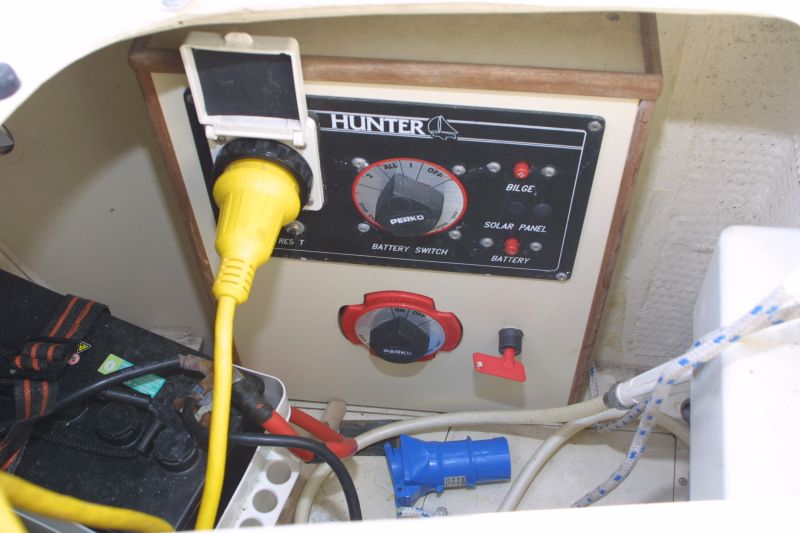
Une prise de quai doit répondre à des normes strictes.12 OR 24VOLT CIRCUITS
The 12 (or 24) volt circuit from the batteries must be equipped with a bi-polar battery switch (+ and -.) The switchboard should at least be equipped with fuses or breakers. The diameter of the cables is based upon consumption and length. On a boat it takes, on average, 2 to 3A per mm². An 8 mm² cable passes, on average, between 16 and 25 A.FUSES OR CIRCUIT BREAKERS
Boards, with fuses, are cheaper than those with breakers. If the fuse is properly sized, the protection is comparable to that of a breaker. The downside, if a problem does occur, is that -
See advice
THE DIFFERENT TYPES OF CONVERTERS
DC/AC converters transform DC battery current to 230 volts 50Hz alternative current. There are also Sine wave converters which provide the same wave form.
They are recommended for sensitive equipment (computer, television.) Pseudosine or trapezoidal converters, much cheaper, are reserved for less sensitive equipment (tools, appliances.)WARNING, LOW RETURN HIGH CONSUMPTION!
A converter does not yield 100%; it averages 85 to 90%. 15% of electricity is, “consumed,” in the conversion. It is better to use the 12v power supply than the 220v for converting. Attention also, to the current consumption, it may be important. If we take, for example, a micro wave oven with an output of 850watts, it uses 4amps at 230volts, continuously at 12 volts that consumption is 4 x (230/12) = 80 amps (with a 90% yield). For this reason, a converter must be
placed as close to the batteries as possible and connected to them with cables sized according to its power.Our view
A
-
See advice
FOR INTERIOR AND NAVIGATION LIGHTS
The LED lighting is interesting for lighting inside the boat. It allows great savings without losing light. One may also use it to replace navigation or mooring lights.
Here too the savings will be substantial but always use certified products. Never take chances with safety.THE END OF A BAD REPUTATION
Hoping for huge savings, users flocked to the LEDs. But these bulbs or complete lamps were not suitable for battery operation. The main problem was the supply voltage. The LEDs are very fragile components that do not support surges (which are very violent when starting the engine for example.) It is imperative to protect them by an electronic circuit. Today all AD catalogue bulbs possess this. Another problem was the colour temperature. If LEDs of colour are very simple (red, green or blue) to make them in white requires more expertise. The first white Leds displayed a very harsh white, today thay are a warm white (which illuminates less crudely,) more -
See advice
CHANGING THE STOVE
The average lifespan of a range is between 15 and 20 years. It may be much shorter, if not designed for use in saline environments. If you want to upgrade to a newer or more complete model, take some precautions.
Measure the length and breadth. Unless you wish to reconfigure your galley, the first item to check is the size. The most critical element is the width. If you have room, you can take a deeper or higher model. Remember to check the clearance at the base.
How many burners? Next come the number of burners: two is a good balance. Three as long as the rear burners are small or arranged in a triangle; two to the right or vice versa. Four burners are not useful at sea.
The right material…polished stainless steel requires significant maintenance. Simple stainless steel is a good solution; it demands less maintenance and also resists salt air. For the oven enamel is by far the best.
If your budget is tight, the right choice is an efficient 2 burner stainless steel