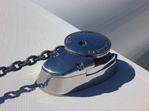
A windlass is a sort of large winch which provides the force necessary to raise the anchor. It is equipped with a gypsy, a toothed wheel designed to hold the chain. Attention; this gypsy must be adapted to the diameter of the chain. For raising the cable, the windlass must be equipped with a warping end; this may also be used as an electrical winch to raise a person to the top of the mast, or for pulling a rope. To facilitate the passage of the chain, today sprockets are mixed (they welcome the chain and block the rope.)
Two possibilities
Electric windlass If your boat possesses an in board motor and you often practice mooring, without hesitation take an electric windlass. For power, up to 6m one can use a 500watt model (traction force of 300kg;)between 6 and 8m a 700watt model, between 8 and 10m a 1000 and between 10 and 15m 1200 to 1500watts. If you often need to raise long chain lengths, oversize, this prevents overheating and will be more rapid. Electrical windlass
The regulations impose an anchor only on boats with more than 4 people aboard.In practice, it is necessary that all boats have an anchor on board. Other than the fact it permits foreign moorings, the anchor also helps deal with emergencies in bad weather (damaged engine or sails.) Even if the second anchor is not mandated by law, it is important to have one on board. The hold of an anchor depends on the bed (rocks, seaweed, sand…)we therefore strongly advise a second anchor, different from the first. The two anchors are thus complementary.
The different types of anchors
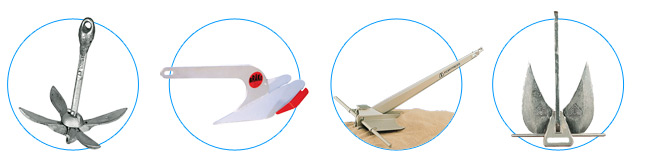
Standard plow, non articulated, flat, grappling, light…which to choose ?
The perfect anchor does not exist for all beds; if it did we would know. This though, does not infer that all are equal and that we should simply choose the least expensive. All tests made by experienced sailors suggest that models with a concave shovel, nonarticulated and tip weighted (such as the MPI brake,)
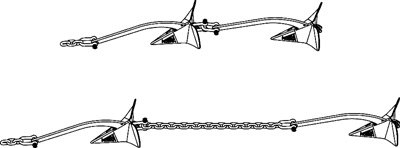
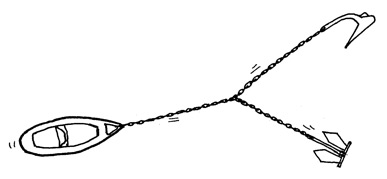
In case of the risk of bad weather, it is wise to use a second anchor, to avoid coming loose. When using two anchors they must be of the same technology to work in the same fashion. Backing an anchor. This consists of using two anchors. If the two do not work on the bottom, the first, closest the boat reduces the load on the rear permitting it to find a hold. Forking. This amounts to placing two anchors in a v in front of the boat. The manoeuvre is delicate because it is necessary to raise the first anchor before disposing of the second. Trip line. In crowded anchorages or on rocky bottoms, it is advisable to put a rope on the anchor. If the anchor is stuck, just pull on the rope to release. One can use the Ocean buoy with cordage relative to the depth and currents of the water.
There are all forms of fender, the cylindrical, to the lens shaped, through to flat and round… Faced with this range, it is often difficult to make a choice and it is tempting, to take a selection, but the cylinders are undoubtedly the most effective.
Boat length Fender diameter Fender Number Supplementary Round fenders 4 to 6 m 10 to 12 cm 6 15 to 20 cm 6 to 8 m 15 to 20 cm 8 28 cm 8 to10 m 20 to 25 cm 8 35 cm 10 to 14 m 25 to 35 cm 10 45 cm
Flat defences
Thanks to their semi-rigid polyethylene foam structure these fenders neither roll nor rise. They protect a large area and do not mark the hull. Space-saving, especially when stored, they can also be used, like their cousins, for the same type of work. It is advisable to use these fenders with a protective shell because they may scratch the hull over time. Ball or spherical defences The spherical fender, if cumbersome, remains a good instant defence at dock, or to ward off danger. This fender is also very useful for protecting