
Page 14 - Our advices
-
See advice
When should you worry?
On a boat that is a few years old, small blisters do not pose a danger. The blisters are, though synonymous with osmosis. One must intervene. The prevention products that are used for processing small pinheads, or even before they occur though, are often more dangerous than doing nothing. If one applies an impermeable product on a not perfectly dry boat, it can actually accelerate osmosis. On a boat with osmosis (large blisters,) action has to be taken. It is a major
operation that requires peeling the gelcoat and controlled drying of the hull which can take months. When the hull is completely dry apply an epoxy resin based product.Understanding osmosis
Osmosis is basically water penetrating the polyester. This water destroys the resin.The boat becomes soft and is likely to decompose. Osmosis is directly related to the components that go into the manufacture of a polyester hull: the acid and the alcohol. This mixture which is added to the fibreglass changes from -
See advice
Fixed or portable?
 The fixed VHF has a maximum power of 25 watts imposed by regulations which limits its range from 15 to 20 miles boat/boat and from 30 to 40 miles toward coastal stations. The new generation of VHF on the market, come equipped with the DSC (Digital Selective Calling) system, ASN (Appel Sélectif Numérique) in French.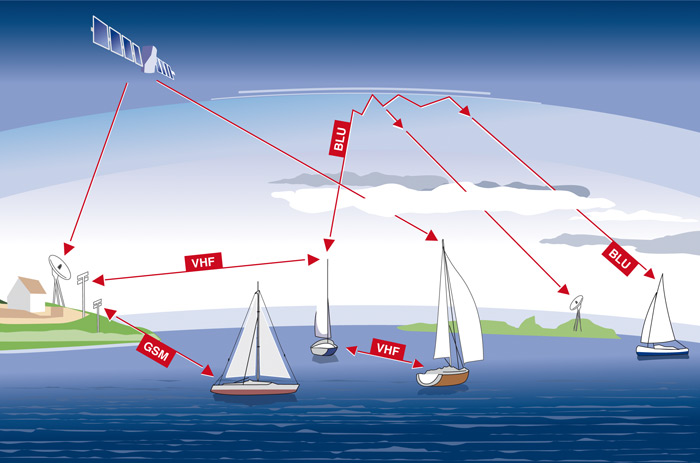
Make the right choice
All VHF, fixed and portable are subject to regulation and certification. Therefore, in terms of standard functions and power they are all identical. What makes the difference is water proofing and additional functions such, as on the fixed, having the possibility of creating a network for
communicating with other VHF on board (interphone,) or of having DSC and AIS outputs, for interfacing with a compatible card reader. On portables, there are small differences in terms of autonomy (capacity and type of battery,) encumbrance, waterproofing and buoyancy.Portable VHF
-A portable VHF can be taken with you in all situations, especially -
See advice
AIS, what for?
The AIS system, transmits to other vessels, equipped with compatible receivers, information concerning the vessel on which it is installed. Thus is transmitted, the vessel’s identification (MMSI number and name,) its position, course, speed, characteristics (length, width, water displacement,) and possibly information concerning its cargo and destination…All this information is emitted continuously, whether in coastal waters or on the high seas. A vessel which receives an AIS signal can thus visualise the course and speed of the sender and assess the chances of a collision long before it occurs. It is therefore, an invaluable tool for avoiding collisions at sea. This system operates on VHF frequencies (161.95MHz and 162.025MHz.) It is mandatory on all vessels over 300 tons and passenger ships. But many fishing vessels and
even recreational boaters also utilise it. For leisure craft, one may choose to be limited to a single receiver. Thus, "we see, but without being seen." -
See advice
What Navtex?
The Navtex (Navigational Telex) is an official international system developed in the area of GMDSS, for sailing professionals. The receivers have been developed for leisure craft. They are simple to use and once programmed, will receive bulletins and keep them stored in the memory.
Two types of receptors are proposed: autonomous with LCD screen for reading messages and without screen with a PC output, which connects via a USB port to a computer.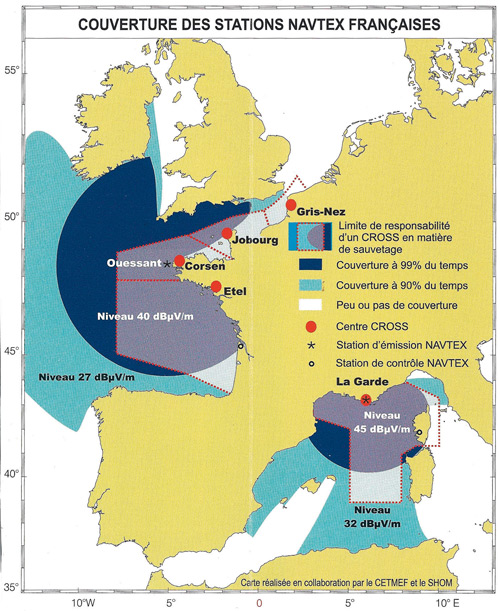
La France possède deux émetteurs (Ouessant au large de Brest et La Garde près de Toulon) qui émettent des messages en français.
Navtex: how does it work?
All transmitters operate on a single frequency, 518 kHz (with a second frequency of 490 kHz to issue national language.) In order to avoid interference between stations in the same area, the diffusion of messages is on specific time slots (every 4 hours) except for BMS. In practice, each service area, called NAVAREA, is divided into geographic area and assigned a letter. For example, -
See advice
Chosen according to navigational needs
In coastal Europe, the weather is broadcast, according to the areas and times, on the long wave (LW 150 to 250 KHz), short wave (MW from 530 to 1620 kHz) and frequency modulation (FM 88 to 105 MHz). To capture these frequency bands, a general public receiver is useful. For long range sailing, it is not enough. An MHF-SSB, receiver is a necessity, sensitive enough for fine tuning. Note that some receivers have an output for receiving the Navtex and weather charts on a computer.The wideband receiver
The CROSS organisation have selected this mode of transmission tobroadcast, on the frequencies 2677KHz and 1696KHz, weather bulletins (with a range of about 250 miles) and for watching, the frequencies 2182 KHz and 2187.5 KHz. Note that outside the range of SSB transmissions, one may receive on short wave (4 to 16MHz, depending on the season,) very detailled bulletins broadcast by Radio France International (RFI.) The transmission frequency is variable (11700